It’s hard to think about what comes next when you don’t know where your children will sleep that night.
For Rita, a single mother of three, that kind of uncertainty became part of daily life.
Rita had needed to leave a dangerous situation for her own safety and the safety of her children. But leaving also meant she and her children, including a newborn, had no permanent place to go.
Rita was doing what she could to keep her family safe—staying with friends and family whenever she could but that wasn’t always an option. What she needed was a helping hand toward what came next.
First, somewhere safe
When Rita connected with Opportunity Council, one of the first steps was learning her family’s story and getting her into the local housing pool.
Despite the name, the housing pool isn’t a waiting list where everyone simply takes a number and moves up the line. It’s triage in a system that simply doesn’t have enough homes available for everyone who needs one. Much like in an emergency room during a crisis where there aren’t enough resources to for everyone, families and individuals are assessed based on their circumstances so that available housing can be prioritized for those with the most urgent needs, including the likelihood of their survival without it.
For Rita, those circumstances included two young children, a newborn, and no permanent safe place for her family to stay. Even with circumstances that urgent, finding a permanent home would take time—time that our community has decided is unacceptable because Rita and her children needed somewhere safe to sleep now.
Thanks to a generous community of donors, Opportunity Council has some flexibility to meet immediate, practical needs. For Rita and the kids, that meant covering the costs of staying in a hotel.
It wasn’t a permanent answer, but it answered the most immediate need.
Her children had a warm place to sleep at night. There was a door that closed and locked. Rita woke up each morning knowing where her family would be sleeping the next night and with the knowledge they could return the next day.
After so much uncertainty, that was a big deal. It gave the family somewhere safe to stay, catch their breath, and do the work of finding a permanent place of their own.
Finding and keeping a place to live can be challenging under the best of circumstances. It means applications, deposits, credit checks and more. Navigating the housing system can be extra challenging—demanding extra paperwork, complicated eligibility criteria, and trying to find your way through systems that don’t make a whole lot of sense when you’re desperately needing a home.
Having one consistent person in her case manager, Cassie, meant that Rita had someone walking alongside her every step of the way. It meant she had someone who knew what her family was coping with who she could call with questions and who could help her find her way through a maze that kept throwing up barriers.
One step at a time
Cassie helped Rita along the next steps: getting a driver’s license so she could get a job, putting her finances in order, and rebuilding her credit. None of those would get them into a home of their own overnight, but each step matters when you’re trying to rent a home, find work, and build a foundation for your family after years of standing on quicksand.
One step at a time, Rita moved forward. Once she had her license, she found a housekeeping job. It was an ideal role and offered the flexible hours she needed as a single mother raising three kids.
Just one thing stood in her way: the right clothes. The new job required all black clothes, and Rita didn’t have extra money to buy them. She’d earned the job, but the cost of showing up for it might keep her from starting.
Compared with finding housing or employment, a few pieces of clothing might sound like a small problem. But when there’s no financial cushion an ordinary expense can be the thing that stands between an opportunity and the ability to take it. And that again, is where the community made all the difference: community donations were used to get a gift card to Fred Meyer and made it possible for Rita to get the clothes she needed for work.
Sometimes a helping hand is a safe place to sleep at night, and sometimes it’s the clothes you need for your first day. A little practical help and a $75 dollar donation made sure the cost of getting a job wasn’t the barrier to starting.
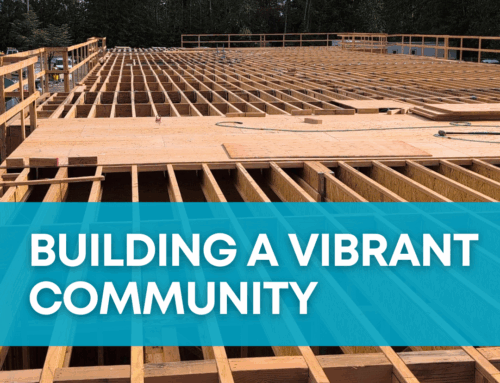
A home designed around families
In June, Rita found out that her and the kids would be among the first residents of Cedar Commons—Opportunity Council’s newest housing community created specifically for families like Rita’s.
Its affordable homes are paired with things that make everyday family life a little more workable. It’s nestled among trees but close to walking trails, bus lines, and basics like a grocery store. It also includes an early learning and child care center and shared gathering spaces. Even the laundry areas were designed for parents of young children, with gated play areas nearby.
Those details might seem small, but so much of life and family are simple, small ordinary things. Having a home means having the space to not have to worry about things like how to manage three small children while conquering the laundry pile.
For Rita, having a home of their own was more than a permanent address: it was a place to raise her children, find a whole community of support, and start thinking about what came next.
The hotel had been the soft place to land—safety and time to figure out what came next. Cedar Commons gave them something different: a home they could count on while building the life her kids deserved.

Building toward what comes next
Today Rita is still building that life. She currently still receives rent assistance that gives her breathing room while she works, raises her children, establishes the household and works towards covering all of her expenses herself.
And she’s looking beyond just today by laying the foundation to create and run her own cleaning business.
There wasn’t a single program or moment or check that got her where she is. And Opportunity Council didn’t do the work for her.
Rita is doing the building.
She left an unsafe situation. She kept her children safe through a period of homelessness. She navigated the housing process. She got her driver’s license. She found a job that works for her family. Now with a little help from others, she’s supporting her family and building a business of her own.
Opportunity Council has been there to offer a helping hand when something stood between Rita and her next step.
Sometimes that was significant, like a hotel room when her family needed somewhere safe to sleep, or a home at Cedar Commons. Sometimes it was having a person to call when the paperwork and systems became complicated.
And sometimes it was as straightforward as a few pieces of black clothing.
That’s what a helping hand can look like
It doesn’t have to solve everything. And it doesn’t mean doing the work for someone or deciding what should come next for them. Sometimes it simply means helping them with a hurdle or two that’s keeping them from the life they’re dedicated to building.
That’s why flexible support matters.
Across Opportunity Council, a helping hand can take many forms. It might be transportation that helps someone keep getting to work. Help with the power bill in the coldest parts of winter. Diapers and formula for a family with a new baby. Or another ordinary expense that becomes anything but ordinary when there isn’t enough money to cover it.
For Rita, a helping hand has looked like a safe hotel room, someone to walk alongside her, a home at Cedar Commons, and the clothes she needed to start a job she’d found herself.
For the next person, it may look completely different. Their next steps could be getting help at home learning to parent and raise a newborn. It could be an older adult getting help with their yard and housework so they can safely stay in their home. It could be updating the ventilation at their house so the air is healthier for their children.
People like you help make sure that when someone is ready to take that next step, there’s a helping hand there when they need it.
This Giving Tuesday, be a helping hand.
This year, Opportunity Council is working to raise $10,000 to make sure families like Rita’s have a hand to grab them before they fall through the cracks.
Your gift can’t take Rita’s next step for her. That’s her path to continue walking.
But you can make sure the ground beneath that step is a little more solid.